
[The following text has been transcribed from four exercise books, originally written by Albert Baker, my great-great-grandfather. Paper was probably expensive, the exercise books were used by his children in school and Albert used up the empty space to write his journal. The original has little punctuation and no paragraphs, both of which have been lightly added to improve readability. Original spellings are used. Some original quotation marks have been interpreted as brackets. Page references in square brackets refer to the original manuscript. There are still some words or sections that are unclear and await a second look.
Victoria Parkinson, March 2017.]
Introduction
I was born at Upper Lodge, Victoria Park, Dover 15th of June 1878, my father being a Constable in the Dover Borough Police Force and I was one of a large family. I joined the same Force in 1900 and retired as an Inspector in 1928; and having seen many changes in the town thought a few lines dealing with them from my earliest recollections and since would be perhaps of interest to Dovorians (and others) and would not be unwelcome to those who can remember a good deal, perhaps more, of what I shall write about about, although perhaps until reminded they may have forgotten a lot about our old town.
I am sorry I have not kept a diary so cannot give dates with any accuracy and will not attempt to include them. There may be an occurrence or two that someone will feel is not quite correct or as they remember it, but I shall put it as it seemed to me at the time and as I remember it, and will not enter into any argument as I want to write a true and clear account of what I hope will be an interesting, entertaining, and in some cases amusing story for the benefit of my readers of all ages.
I have in my possession what is known as a Centenary Pot, or white China mug, it has the words printed in gilt on a sort of scroll Sunday School Centenary 1880. Richard Dickeson. Mayor. Dover, with [page 2] two gilt rings, one top and one at bottom which was given to every Sunday school child attending a treat in Northfall Meadow in 1880.
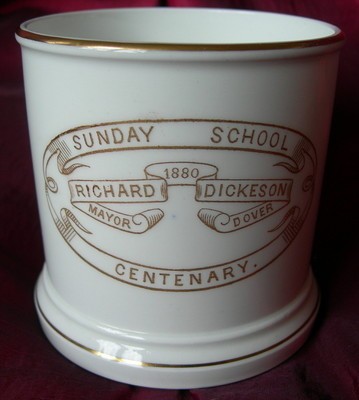
I don’t remember receiving it, and how I came to receive it I don’t know as I was not old enough, perhaps I was taken to the treat to be with my brothers and sisters, but I do remember my brother had a hobby-horse as a present, that is my earliest recollection. All my sisters and brothers of school age had a similar pot and mother took great care of them and as they married each was handed their pot undamaged and they prized very much. Sir Richard in his earlier years (so I understood) had failed in his business but later paid all his creditors in full and became a prosperous wealthy man, he was very generous, took a great interest in town affairs and was mayor several times. He presented racing boats to the Rowing Club and did everything he possibly could to make things easier for all classes, sending out xmas gifts of grocery etc. to a large number of the inhabitants and Corporation employees.
He had a very large “Wholesale & Retail” grocery business in premises bounded by Market Lane, Queen Street and Tavernors Lane with a large bacon factory and stables in Tavernors Lane, also a Tallow-Candle Factory and stables in Market Street.
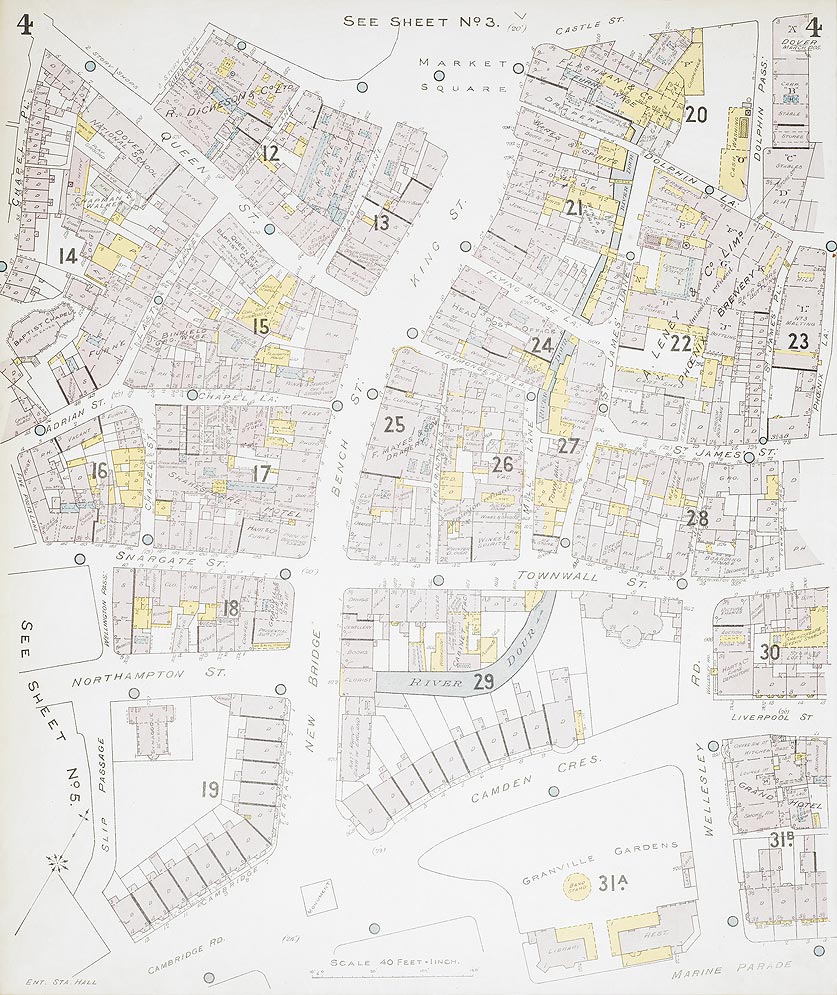
In the top left of this 1905 insurance map of Dover, you can see the R Dickeson buildings.
The smell from the candle factory in early morning was vile, but it was said you could get used to it. I never did. You could [page 3] smell it a long way off if the wind was right, it seemed one of those smells you can taste, and never disguise. All his vans were drawn by dappled grey Horses, no other colour, and were not allowed to trot and were usually in pairs, any, and every day during the week they could be seen going on journeys to neighbouring towns, villages, and camps. He also did a large business in supplying troops, camps and canteens; for hill work he always had one or two tracehorses and his horse keeper for to it that they were all well conditioned and cared for. In later years the business became the N.A.A.F.I. with main offices away from the town.
From my earliest days, I can remember the Kent Artillery Militia being embodied annually, in May, and going to the barracks at Fort Burgoyne for 28 days training, some of them were really a rough looking lot when they came up, hardly better than tramps and had a painful job too march in their boots which had been served out new and brown in colour that they had to turn black somehow. I have seen stragglers with their boots hanging around their necks and walking barefoot or sitting by the roadside, as their feet were in no condition for new boots after tramping the country. Nearly all army boots were issued brown and the men had to get them black, sometimes a long process as the leather was so greasy. Some of the men were no doubt alright, [page 4] but others would sell their shirts (greybacks) off their backs for a small sum, also bring boots out for sale to civilians, frequently not their own, and these were mostly sold in low-beer-houses or dark passages etc. but if civilians were found in possession of any Government property they would always be prosecuted, so it was risky to buy until after they were disembodied when each man received 30/- Bounty unless in debt to the Crown, also his underclothing and boots.
There is in Laureston Place a pair of semi-detached houses, the lower one of which used the be The Plough P. H. where there used to be frequent rows especially when the men were returning to barracks after an evening in the town. I have with my brother often found Tunic’s, Caps, Belts & Shirts in the early morning lying on the grass in Victoria Park where they had been dropped or thrown when the men quarrelled and fought or had a snooze and then forgot to pick them up. We would gather them up and somehow gain admission to the Fort, (the sentry being one of themselves) and try to return the articles to their rightful owners and were usually rewarded with a copper or two if they had any left after their night out, or they would promise to pay when they got it, it meant a lot to them as they would have lost everything when disembodied.
The regulars, Royal Garrison Artillery were stationed at the Castle and Infantry at the Western Heights although some Artillery [page 5] were at the Devils Drop, or Drop Redoubt Saluting Battery when the saluting battery was shipped from the Castle for a time. I was a choir-boy at “St Mary’s in the Castle” and with boys from the married quarters, next the Keep, used to visit the Cliff Casemates and other Casemates, mostly fully occupied as barrack rooms, especially at Xmas time as the Canteen Fund supplied fare including all sorts of nuts, fruit, and poultry for all the men, many of the rooms were tastefully decorated as the men tried to out do each other. Officers and their wives would make a tour to inspect their efforts just before dinner-time and afterwards we would get surfeited with nuts etc.
The tall buckets they usually carried the tea from the cook-house to the barrack-rooms would contain beer which was also an allowance per man from the Canteen Fund. Viz:- profits from trading: only essential duties were carried out after the Church Parade. As boys we could go almost anywhere without let or hindrance although some of the roads there always marked “Closed to the Public” we simply just walked where we thought and often went through Pencester’s Gallery, Drawbridge and Tunnel to the Northface Meadow but that is, and was, reserved for Military use only.
There have been many notable Generals Viz: Generals Newdigate, Seymour, Montgomery Moore, Butler etc etc in residence at Constable’s Tower when in charge of the S. E. Command and I have known most [page 6] of them very well by sight, some would nearly always be on horseback with an orderly escort from one of the cavalry regiments at Shorncliffe or Canterbury riding a short distance behind with Lance & Pennon, riding in true Cavalry fashion, and who was quartered at the Castle for their duties, stabling near the Spur Battery.
Soldiers did not then wear khaki and for fatigue duty had hard shiny canvas overalls. Each regiment had its own particular dress with facings and pipings and looked very smart with leather belt pipe-clayed with crest on the fastening and the various decorations and headdresses. The Artillery wore a Royal Blue, the best tunic had brass buttons, about 8 in centre down front and 6 at the tails. 3 each side, each impressed with a cannon, on the stock around the neck about an inch each side of the opening, a brass grenade bursting and down the side of the trousers leg a scarlet insertion of red cloth about 1 1/2 inches wide. A Forage cap shaped like a pill-box about 2 inches deep with a yellow band about the half of its depth on the lower side and a yellow covered button in the centre of the flat crown with patent leather chinstrap and a swagger came usually with the Regimental Crest completed the walking out outfits, the cap was always worn on one side and with the hair plastered down to be formed over the forehead into the quiff some of the men were real smart soldiers, and of course there was discipline in those [page 7] days to keep them up to the mark.
I have frequently seen a fatigue party with a huge heavy two wheeled barrow or cart with wheels big enough for a tip-cart come down to the town for goods with drag files attached to the wheel caps to hold it back with one man in the state which were very heavy and then with the goods obtained the whole party pulling straining and sweating to get it up the hill again, why a horse was not employed I could never make out unless it was to get the men fit and strong for hauling the guns as they were big fellows mostly training for Mountain Train Batteries in India etc. it was hard work.
Another thing that would be interesting today would be to see the troops of various infantry regiments from the Western Heights on a Route March for training purposes, each with a barrel shaped watercraft usually drawn by a mule and Red Cross waggon at the rear of each regiment. In the van of each Regt a small body of Pioneers, usually these were big hefty men wearing leather aprons, mostly with full bristling beards and looked able to deal with any obstruction. I think the beards were to make them look fierce, they each carried some tool or implement such as a Saw, Axe, Crowbar, Crosscut, etc, they were the first ranks after the band, C. U. and other officers mostly mounted and followed by the regiment in columns of four with non-coms on the outside. Recruits also prisoners [page 8] at the rear, not carrying arms.
On returning the Bands, Drum & Fife, Brass, or Bagpipes could be heard long before the troops arrived coming down the Hill. At Easter there would be combined operations and a big Easter Monday review of Volunteers (now Territorials) who came in thousands from London on Friday, Saturday and Sunday and would be accommodated at various schools, Imperial Hotel (now the Burlington Liverpool St) which was standing unoccupied for many years, and other places. Boys with their eye to business would be early outside the different places acting as bootblacks and get quite a lot of customers. Very early on Monday morning the big guns were on the move drawn by 6-8-10 horses, the best shire horses the town could provide and harnessed to a gun they had all their work in getting up the hill as the manoeuvres were usually held between Walmer and Dover but sometimes in the Hougham district.
I remember a heavy and severe snowstorm one year during the March Past one Easter Monday near Tapley Farm, Elms Vale Road (where the new sports ground is now) and seeing the London Scottish Volunteers in kilts racing down the hills through the gorse to Fall In for the March Past. They must have been scratched about.I think it was the Duke of Cambridge took the salute, whoever it was must have been cold sitting on horseback whilst the men in fours marched past.
At Easter, Tommy Lee’s Fair with round-a-bouts, swinging boats and [page 9] Cocoanut [sic] shies from Ashford always arrived on the previous Thursday and finished in the Northfall Meadow, later in Castle Hill Farm grounds and later still at the junction of Elms Vale Road & Folkestone Road opposite the drinking fountain on Dave Curling’s [?] ground of Priory Farm. Tommy & his wife were very short and fat & jolly, were much liked and did very good business with the troops and townspeople.
Maidstone House (Dr Waughs) was the last house in the town on the right hand side of Folkestone Road with the exception of the Flint Houses at the water trough, Gordon Lodge and the top of what is now Vale View Road and some farm buildings at Priory Farm, all the rest was pasture or arable land. There were no houses between Belgrade Gardens and Shakespeare Road, all that land right back to the hills being under cultivation ( I think the property of the Coleman Brothers Crabble Hill) and had a rough bank steep and broken about studded with Elders, Brambles & Nettles about two thirds of it is now known as Westbank Gardens, then Lindisfarne at the bottom of Shakespeare Road and a few small houses to the Orange Tree P.H. and Dovers Diamond Brewery, then four small cottages on the hill and the Hare and Hounds P.H., no more buildings at all facing Folkestone Road.
On the right of Folkestone Road from the junction at Elms Vale Road no houses [page 10] whatever, only fields for cattle grazing where Church Road, Lascelles Road and Malmains Road are now. Castle Hill was much the same as now until you reach the hedge above the zigzag. There was no hedge then only a rough bank down to the old Castle Hill Road and that was very rough for travelling with patches of bushes on the banks, Elder trees, deep runnels in the chalk roads where the rains washed down into a pit at the top of Launceston[?] Place to catch the stormwater and gravel so that the latter was able to be dug out instead of going into the drains, another smaller one is still in existence close to the top entrance to Connaught Park. I know because my younger sister fell in trying to get out a wooden betby[?] Dutch doll that she saw and I got her out.
The zigzag was made in hard times in the early 80s to help the unemployed, that and top portion of the Park. My father had his vegetable garden there, where the entrance to the Park is and it had a five-barred gate. At the top of Connaught Road, we used to call it Waterworks Hill there were two cottage set back well into the bank close to the top gates of Connaught Park and overlooking the grass covered reservoirs of the Waterworks. I have had several arguments about these cottages and now have in my possession a very old photo showing them in the position I had claimed, [page 11] one cottage was occupied by someone named Hogbin and he used to keep an eye on father’s garden and pigstyes (sic) during his absence, or when we boys were about as that was when carrots used to disappear.
I don’t remember the Toll-gate a few yards down the hill from Castle Hill Farm but I do remember seeing the wooden posts still in position for the fencing on the verge next to Northfall Meadow to stop anything passing without paying Toll when the gate was in use. The pond at Castle Hill Farm was the usual place for skating during hard weather as well as the longer one at Frith Farm.
Tobogganing down Castle Hill from the extreme top right down into Castle Street during and after heavy snowfalls was a practice from early morning till late at night, sometimes all night, and causing complaints from Victoria Park as there was so much screeching and noise, horse traffic became impossible as the surface became like glass and the only thing to stop it, and did so later, was for the Council to send tip-carts of clinker and cinders put down very thickly in bells about 6-9 ft wider at intervals of about 40 yards. I have seen troops with two sleds with a long ladder fixed between them and quite a number of men sitting on the ladder rush down the hill at express speed but they usually came to grief at the first bend just above Victoria Park there or the one just below No 1 Victoria Park. Each year there were accidents, some very serious and eventually the practice was stopped altogether in 1892-3. Sometimes the slower sleds were overrun by faster ones and got out of hand, all sorts of things would be used as sleds, teatrays etc. [page 12] with no way of controlling their run.
On Queen Victoria’s birthday a Feu-de-joi would be fired from the ramparts around the Castle, overlooking the town. Infantry marched over from the Western Heights would be lined up in double ranks at noon. First: 7 rounds from the saluting battery at “Monkeys Point” near the Officers Mess in the Castle, then the rattle of independent firing from rifles or carbines, starting near Canons Gate, from rank to Constables Tower and returning by rear rank to starting point, the men remaining ready with firearms pointing skywards whilst one Verse of the National Anthem was played by massed bands, then another 7 rounds from the battery, during which the troops reloaded and the process repeated until 21 Guns, and three volleys of small arms fire had been fired, then deep silence till the G.O.E. (with his subordinates then in full war paint, cockades of feathers, etc.) shouted out at the top of his voice. Remove Helmets, three cheers for Her Majesty the Queen. Helmets were put over the muzzles of the carbines and as each cheer was given they were raised up at arms length. In those days every man was entitled to a pint of beer after being dismissed.
As the troops were withdrawn from the ramparts there was a rush of boys to pick up any discharged cartridges that had been dropped and there were always some, they were made of thickness of paper or cardboard with the top turned in the only metal being the end containing the percussion cap, if among us we found enough to make a “blue devil” as it was called we made a heap of powder, damped it into a stiff paste, ran a train of dry powder to a distance and fired it: Result a big [page 13] puff of smoke, no report, it was a dangerous game if too close when the explosion took place.
I remember a Vault in Hubert Passage and had read the inscription on a small stone close to the ground many times “Entrance to Butterworth” but did not give it a second thought until one morning on the way to school men were digging up the ashphalt path in a semi-circle to receive the last for interment there. I told some of my schoolmates and at 12 o’clock we ran in a body of several and found a hole covered with boards, the men having left for dinner, some of the more daring boys went down a short ladder standing in the hole just below the surface which the men had been using whilst I was to give the alarm and help them up if anyone came, no one did come and I then said I would go down if they would tell me if anyone approached; as soon as I got to the bottom the boards were replaced and I could hear them running away down the passage. I climbed the short ladder and tried to lift and move aside a plank with my head but the ladder slipped on the wet limewash that had been slopped about when the sides of the hole had been whitewashed to make it look clean for the interment and I fell to the bottom, just then I heard someone slowly coming up the passage so kept quiet hoping they would pass by, but no, a board was lifted and I don’t know who was most surprised, in was my Sunday School Supt. W Austin of the firm of Austin of Lewes: he said what are you doing down there and I replied:- some boy threw my cap down Sir, he held the ladder and helped me get out and questioned [page 14] me as to what I had done in the vault and if I has been under the Church at all and after a serious lecture I was allowed to go. I often wondered in after life when he was a councillor and I saw him, if he remembered it.
Old St James’ Church had many old charities for the benefit of parishioners (I believe more than any other church in the town) and at given periods a Bread Charity was advertised and distributed from the Vestry Hall adjoining the Church when aged parishioners could be seen, some with pillow-cases to carry the bread away, there were also Charity Coals and during the winter months a load of 1 cwt [hundredweight, 112 pounds, around 50kg] Bags of coal was drawn round the parish accompanied by a bell-man who rang his bell and then shouted out as loud as he could. Charity Coals, if one had been successful and obtained a free ticket from a subscriber (most of the local gentry and forms were subscribers) they would present the ticket and 2d [two pence, approx 1p] To the bellman and in exchange get a cut of coal delivered, no one to receive more than one a week.
There were also Soup Tickets to be obtained free from subscribers entitling the holder to a quart of soup from the Soup Kitchen in Younders[?] Court at noon with a small loaf about 1lb. Children would be released from school in time to fetch and take it home. The different receptacles used by various families to fetch the soup was interesting, handleless jugs, old cracked washhand jugs with sometimes lip and edges missing and in some cases where there was a big family they wanted and had very big containers pressed into service. Where have all these Charities [page 15] and Legacies to the parish gone, since the parish is destroyed.
Opposite Old St James’ Church toward what is now the top of St James’ St and about where the Public Convenience stands, stood a large house occupied by Dr Parsons next door to Stilwells & Harbys Office the house had a basement and a large sunken area in St James’ St but the front door also in the same street was reached by a low step or two and a flagged pavement as the house itself set back several feet from the street, the area was protected by heavy iron railings, set on a dwarf wall which continued on a rounding bend into Woolcomber Street with garden to a depth of about 90ft [90 feet, about 27m] At the end of the railings was Dixon’s shop. “Greengrocers & Wood & Coal Dealer”. (Then the King William 3rd or 5th PH (I am not sure which) kept by someone named Holt, then “Broads” the baker and J Busseys Coal Store, then a narrow passage with high walls leading into Upper Townwall Street now called Clarence Place [Street written above Place in the manuscript], the wall next the Imperial Hotel was later removed, the Hotel (later the Burlington) I had never known occupied as an Hotel but it afterwards had a resident caretaker Police Sergt. Paul Hanson who lived there with his family for some years.)
Mr Dixon who was short and very thick set was lamplighter and extinguisher for my home area also for other areas adjoining, he used to puff and blow hurrying up the hill so as to get all lighted up by dark, and again to get them all out by dawn. During the Winter we heard him go up to the highest lamp overlooking and illuminating Victoria Park Mews as there is a high wall with drop that would be dangerous in the dark [page 16] and back again to light, I think four more on the edge of the grass in Victoria Park, we knew his footsteps and were often awakened in the early morning by his heavy boots, (there were no rubber heels in those days) almost at the sun coming down and turning into the park. In snowy or bad weather it was a difficult job, he carried a plain sodden pole with an elongated or tubular perforated brass top about a foot long fitted on closely, containing a lighted candle, he pushed “on” the tap with it and then lifted a small hinged flap as he pushed his pole inside against or near the burner and ignited the gas as it escaped. There was no incandescent lighting, just the old-fashioned ordinary fish-tail burner, but still it was a light. Often the candle would get blown out in rough weather and he would ask mother’s permission to come in to relight it. I think the Gas Co. provided the safety matches, otherwise with the ordinary matches then in common use the Tandsticker he would never have got it alight. The Tandsticker had a coating of sulphur about a third of its length and the head dipped in a red composition, would strike almost anywhere and then be held in cupped hands till the sulphur was burned and the wood alight, not nice smelling if you got a sniff, most labouring men struck them on their buttocks. Extinguishing was easier as the lamp being alight the tap could be seen and be easily turned off.
Opposite Dr Parsons top-left of St James Street was Tristons[?]Bakers shop adjoining the entrance to Castle Place and on the lower side of the opening “Coppens”Carpenter [page 17] with side premises as workshops. About 60ft [60 feet, approx 17m] into Castle Place on the left and facing the back of St James’ Street was a row of cottages, then a few more facing Castle Place and another opening with a row of cottages each side. They were all of the same pattern, a basement with tiny yard approached by stairs from the front door, a front room and I believe two bedrooms, the approaches were clean with asphalt or flags but I don’t think the first row was fully paved as I remember Hollyhocks there. I don’t want to exaggerate but I think there must have been well over 60 houses there. When they pulled the place down the road was widened to what it is now and for years Transfields Circus, a temporary wooden erection used the area till later it was built on for the Oxygen Company and is now a showroom & filling station for motorists.
On the “E” [East] side the high wall was altered and built up for Sir Wollaston Knocker, Town Clerk, who lived as Castle Hill House. There used to be a gasometer at the extreme top of Liverpool Street and close to the cliff under “Shoulder of Mutton Battery” (entrance from Castle Hill) and another gasometer in Fectors Place where the East Kent Garage now stands and Mr Lockwood was the first road foreman I knew, he was a live wire, always busy, and an asset to the town, pity there were not a few more like him today, his wife kept a small sweet shop in Woolcomber Street, St James’ St until this [page 18] last war with its shelling & bombing was always a busy street with soldiers & wives coming and going so Snargate Street which was the shopping centre at that time. There was the Golden Cross, Bell Inn, Fox and Red Lion PHs all of which are now closed. The Red Lion like the Lord Nelson in St James’s Lane were Common Lodging Houses. The Red Lion Licensee Mr Dane had a rough cobbled yard with gate where anyone travelling with a barrow or knife grinding machine etc etc could put it, next door in St James’s Lane and adjoining were 3-4 small cottages and then quite a large house facing up Flying Horse Lane, continuing to the open brook between Flying Horse Lane & Dolphin Lane were six cottages now used an a coal store by Fremlins. Opposite the Red Lion at the bottom left corner of St James’s Street was a very old and picturesque house latterly known as “Chatwins” bird shop. It was said the Dover-London Mail Coach used to turn that corner, if so, the driver must have been a wizard with the ribbons. Many artists has [sic] sat and sketched and painted it, but it went in the shelling.
Townwall Street was almost a cul-de-sac as upper Townwall Street now known as Clarence Street above the backway to the Fox PH ended in only a very narrow passage into Woolcomber Street and the passage through Arthurs Place to St James’s Street, another next to Eriths stables and only wide enough for one at a time, had no name that I know of but we always referred to it as Bogeys Alley. The top buildings were mostly Eriths, later [page 19] Gibbs Stables and “Holmes”, Painters Workshops. The Susan PH & Granville were blown away and the whole area at present is derelict. A small shop next the Granville kept by Mrs Davies used to do a good trade with the gentry for poultry, pork & vegetables and a small fish shop next to the Robin Hood PH kept by Mrs Spise had a good connection with the gentry. A sturgeon in a glass case attracted my eye and I had a hope of seeing a fresh one but I never have, you could see things that today the younger generation never see, or very seldom. Fancy a huge codfish known as crimped cod hanging up by the tail with the cutlets already crimped and separate, only the backbone to be cut through. That was done by suspending a freshly caught cod by the tail, the fish apparently dead the folds and flukes were then plain to see and incisions made between each fold, the cut nerves causing the crimp. How about “Crusted Whiting”, in great demand are lime, seldom seen now, the whiting was skinned eyes removed and the tail passed through the orbits, after skinning the fish had a silvery appearance and were sometimes called Silver Whiting. Then again, when did you last see Fennell on a Fishmongers stall, many have never heard of it but it was always to be seen during Mackerel season, it grew wild on the shore and cliffs. Again: where are the Whelks, I don’t just mean mud whelks imported into the town for bait, but the deep sea Whelks caught in the trawl 6” long or more, tender, tasty and clean [page 20] no sandbags to get rid of, I should like to take them again.
On Nov or Dec evenings there was most times a strong smell of sprats frying, often they were sold at 3d per hundred [approx. 1p per hundred], long hundred 120; now they are about 10d [4p] per lb, how many pounds in 120 I wonder. It makes you think. Eastbrook Place had a rather bad knocking about. Mifs [Miss] Kentisks [?] garden as it used to be known, latterly known as Wyham House, occupied by F Davis is a wreck, there were lovely fruit trees there, I have sampled them as a boy, including the Mulberries, there are not a lot of mulberry trees in the town, now mostly old and iron bound to keep them from falling apart. Harold Cottage has been repaired but the new St James Church I understand is too far gone to be repaired, if so, it means both churches, boys, girls and Infant Schools, Vestry Hall & Parish Hall all wiped out and nearly all the houses in the parish as well. From St James Church to Saswell Street was a hedged allotment garden, then two houses, more allotments and then the Catholic Church. Father Lewis was the R.C. Priest for many years, he was rather small in stature and frequently would come by himself for a walk through Victoria Park, he seemed to like to be by himself.
At the back of New St James Church now called Harold Passage (to us known as Lights Lane as the Reverend Light used to live at the rectory at the bottom) was a rough stinking passage with 3-4 shorts [sic] flights of steps and several buttresses which extended nearly across [page 21] the path and was nearly every night and day used as a lavatory, it was a disgrace until the buttresses were removed, lamps places on top of the wall a longer flight of steps put in at the bottom and the path surfaced and made good. Lauriston House was occupied by the Rev Hammond. I know he had no living but occasionally stood in at Charlton Church. I think he was well off financially, he took snuff, and I believe was a single man. He had a lovely Cherry Apple tree just inside the gate. I’ve had some, and I think it was there I first saw Medlars. He used a bath chair with an attachment of light iron for shafts to fit a donkey to be harnessed to and accompanied by an old ostler named Pooley who walked at the head of the donkey and held its bridle. They would often be seen taking the air. The donkey was stabled in the building just inside the gate in the wall at the top of Lauriston Place. I think Pooley had a room there to live in.
There were many notable characters in the town I could speak of but even if some things are amusing I think I shall skip it. Frith Road as I first remember it was a number of deep excavations where the County school stands and on the opposite side where St Alphege Rd and Avenue Road are it had rough wide spaced boards fencing and was being grubbed up for [page 22] flint stones by a man named Robson, always referred to as Cocky Robinson and the ground was excavated as far as, and up to, a high wall in Barton Road enclosing a garden and orchard of Barton Farm, there are not many stones left in that land as flints fetched a good price for road repairing. The farm house itself set rather a long way back from the road and faced Barton Road, approached by a farm track road, grass at the sides, big horse-chestnut trees near the highway and each side of a five barred gate, it was just about15-20 yds beyond what is now Beaconsfield Avenue. On the opposite side of the road were two old farm cottages with fields behind and a rough track as far up as the railway embankment, no other building whatever on either side of the road which was very narrow, a footpath led down and round the farm (about where Limes Road is now) from Barton Road to Barton Path then running left to the old footbridge, now replaced by the road bridge Beaconsfield Avenue there was no path to Cherry Tree Lane as the meadow ran right down to the Dour, sheep usually grazing there, on the other side of the Dour was a rather sunken area sometimes flooded, it was later used as a refuse tip, levelled up and later built on by Mr Warren.
Barton Road and Buckland Avenue as now known was a narrow third class road with allotment gardens on the N. E. side approached [page 23] in most cases by rough made steps made by the occupier and were quite high and steep in places as the bank rose almost sheer, there was a depression opposite Cherry Tree Lane so that a cart could go up the incline. On the left after passing Cherry Tree Lane were level gardens fenced in, till one reached Willow-Walks, with its backwater from the dam at Mannerings Mill where most old Dover boys have carried a jampot to capture & take home minnows. Then passing Buckland Farm we come to Dodds Lane at the junction of which with Crabble Hill was what I was told the Toll-house, (I never saw any Tollgate) it had a very big clock dial plain & flat to the wall, if I remember rightly the occupier was named Bowles an ex-policeman. After passing under the bridge was an opening on the left hand side by the embankment to allow animals to get in to pasturage, a high hedge obscured the view of the meadow later used as a Nursery by W Kemp and near the road much later houses were built combining into Crabble Road. On the right after passing the Gate P. H. was rough ground, no Pioneer Road or houses at all. On to Crabble Meadows. No Athletic Ground or Cricketers P. H. just a path only, with a click gate about halfway which we as children always raced to so as to push it to and fro for one at a time to pass, there was always a large hollow tree stood out in [page 24] the meadow between the path and railway that always seemed to me to hold some secret but owing to the field being fenced [?] I never satisfied myself about it.
The two cottages at the top of Bunkers Hill were there but nothing else. Coming down London Rd after seeing the yew in Buckland Churchyard that had been dug up and moved and still lived, although old, we saw the remains of Hardings Brewery, next to Mannerings picturesque old flour mill the machinery of which was later modernised and is still in full production & next again past the opening to Lorne Road the lovely old-fashioned house with large garden, stables and ostlers quarters with semicircular drive in to front door and was occupied by Dr Ross, down to the crossroads by the Eagle P. H. where it is said the last public execution in Dover took place, then on to the Maison Dieu Hall and another fine old house recently used as a Surveyors Office, past the Salutation P. H. spoken of in the Kentish Register of 1793 when the landlord said he had 5 ankers [approx. 37.8 litres] of cains [?], he was offered a £5 note for some but he declined saying he would take gold but not paper in exchange and so back home.
Another walk we used to take on Sunday evenings, if fine was to Crowhill and Swingate. Father in tall silk hat, frock coat, Bandana silk handkerchief (which I still have) spring side boots, Malacca Walking Stick with thick Antler horn handle with heavy silver band, Meerchaum and Amber pipe, heavily mounted in silver and smoking (not a cigar) but rank 3d [page 25] per oz “shag” tobacco. I can smell it now, beastly stuff.
Mother who in those days was on the plump side wearing a long gold chain twice round her neck and reaching to her waist with a small gold watch in pocket on breast and wearing a very large cameo gold mounted broach, a smart bonnet with almost always an Aignette which I thought very smart, nearly always a black dress with a bustle, which was the fashion, a veil hanging to her chin level, a small tippet or at time a small feather “boa” mostly made of cocks feathers. There was quite a procession once we had got going, the perambulator was a three wheeled wooden affair, two large wooden wheels at sides and a smaller one in front with iron tyres like a miniature tip-cart, (no rubber tyres then) not much room to lay a baby in, it was for one sitting up, but at the front a toddler could sit if too tired to walk, with its legs dangling. We would take the Guston Road, at the junction of that road with that to Fort Burgoygne on the left hand corner was a low one story [sic] tarred hut where the shepherd (name Limnell) to W Baldwin, Castle Hill Farm lived, he had two or three boys and a crippled wife or housekeeper, we used as schoolboys to make fun of one of the boys, perhaps not so brilliant as he might be, more to our shame, but I suppose boys are cruel sometimes, he never took offence and I have when thinking of my schooldays often felt sorry about it [page 26]
The hut was little better than a pigstye for anyone to live in. After we had passed the hut there were no buildings at all except the Fort itself inside the trenches and after passing the Fort we crossed the Parade Ground (now enclosed for “Duke of Your” school) making towards Crowhill and looking about for mushrooms as grew there very freely in their proper season. After passing the cottages at Crow Hill we turned right to reach Swingate P. H. without touching Guston. Sometimes we would have a few peas, a turnip or swede or a few ears of wheat rub it out between his hands, blow on it to winnow it and tell mother to open her mouth, she used to have a bit of a job to bite or chew it. On reaching the Swingate P. H. father would have a pint of beer 2d, mother ½pt and there was the old stone bottle of Ginger Beer for us, but never so much as we should like but I think we understood we could have all we wanted if they could have afforded it, a boy could drink a lot of it even if he wasn’t thirsty, so we had to watch the glass and call out if one was drinking too deep.
Then there was the naked “Ringwould Biscuit” for us children. I don’t know who made them or what they were made of, they were round and very thick, about 4” [10cm] across with four knobs spaced equally on top. It was impossible to get your teeth into them and a boy can usually [page 27] eat anything if at all hungry. The only way was to grind your teeth around the edge to get a start and then keep grinding as you could never get it soft and it would last all the way home. I have tried about 25 years ago to obtain one of these biscuits but was told the man who made them was dead, perhaps he managed to eat one, they were like cement and the hardest food I ever tasted.
If father was off duty on Sunday evening and it was wet, or during the Winter, the paraffin reading lamp with opaque shade (an improvement on the old clear glass bulbous chimney lamp) was after tea was cleared away placed in the table centre, the Family Bible was got off the sideboard and one of us selected to choose the Book we should read from, but if thought too advanced or unsuitable for so young a company Mother or Father would decide. Father would read a verse, pass the book to Mother and in turn we all had a verse to read, some of the words were difficult but we got over that by spelling and rendering them in English as she is spoken. We always sang “Grace” before and after every meal, and said our prayers at mother’s knee the finest being “God bless Father and make him better” which had originated when Father was lying grievously injured in St Thomas’s Hospital London, the result of being beaten up by a crowd in an attempted rescue of a prisoner in Bridge Street. We always kissed our parents when going to bed and [page 28] my mother would always look for me to kiss her whenever she met me, expected it and I did not disappoint her. Once on Point Duty (when she was over 70) at the top of Snargate Street, she came up to me and made folks stare as she kissed me and passed on. She was a good mother and would do anything for our benefit.
I remember a very heavy snowfall when we were snowed in, it being level with the windows and only father could manage to get through with great difficulty, a gang of men were sent to cut paths sufficiently wide to deliver necessary goods in the Park the snow on the Gusham Road had drifted up over the banks from Croft Hill and completely blocked it, the surplus falling into the moat at Fort Burgoyne, on a small triangular piece of ground nearly past the Fort on the right hand side, it was piled so high that in the late summer there was still dirty snow, hard and granulated like ice, or coarse salt.
In the town were good class shops of different trades, but no Co-op. The first of them that I remember was at the corner of Market Court, Market St but I don’t remember if that was the name traded under, I don’t think there was one at River then. I should recognise the names of some of the first. I think Fakely and Rayner were two. The first Electric Light I remember was made to supply 4 or 5? large lamps outside Mitchells Bookshop, where is now the Soldiers Institute 157 Snargate St, the current [page 29] being made on the premises, they were I think the first to introduce Plimsolls then known as sandshoes and they distributed free puzzle cards with hidden frases [sic] or objects, very interesting and like later cigarette cards the boys used to change with others to get a variety. The 6 ½d Bazaar was at the Wellington Hall and the proprietor a W Edwards, I don’t remember anything about W Squiers only the brass door sill at the entrance bearing his name, it was afterwards used as a Salvation Army Citadel. Waxworks, Glass-blowing, Cinema etc etc. We used to go to the Apollonian Hall, just below the Clarendon Hotel and adjoining the Apollonian P. H. (next the corner opposite the Bethel and backing on to the Commercial Quay) to see the marionettes which I always enjoyed and thought most clever. The Hall was a good size and had a gallery and was used for Dances, Private Theatricals, Catch Club and other society functions. At the Grand Shaft Entrance was a sentry marking to & fro from the gates to the pathway in full uniform of one of the infantry regiments stationed in the Western Heights, with rifle and fixed bayonet until the evening when he would stand by his sentry base just inside the gates and after 9:30-10pm the gates would be padlocked, anyone seeking admission after that had to rattle the chain or gate give the password, go to the Guardroom and be seen by the Sergeant of the Guard.
We had very few amusements other than what we made ourselves [page 30], Marbles. Cricket. Cat and Stick (my favourite) played at the junction of Canons Gate Road and Castle Hill in the roadway, paper-chases etc etc and were happier and more contented than children of today, surfeited with toys not knowing the value of money and usually getting what they ask for. If for some little service someone gave us a copper, half would go in the money box and feeling beyond the dreams of avarice the rest would be squandered in riotous living “Dosh and Scorched Peas” at Angel Baileys little shop in Woolcomber Lane and later St James’ Street near the Golden Cross P.H. Angel was a little lovable woman, not too well blessed with this world’s goods, but she always had a smile and cheery welcome when we went to the shop. It grieves me to have to confess that I as well as other boys would cheat if possible and purloin a few extra peas if they were left near the counter, she also sold fresh cheeses Junkets for 1/2d or 1 d. She was I think one of the most good-natured contented women I have ever known, we never called her Miss Bailey only Angel, and she was one.
Pooles Myriorama or Diorama about once a year at the Town Hall was not as good as a magic lantern as the pictures shown were only a roll, rolled round & round with someone to explain the scenes shown as they passed. Of course there were no movies then, but some Magic Lanterns [page 31] slides had an attachment with a handle to turn showing all different colours locking and interlocking in the screen which we thought a marvellous job, and a few nu manipulation could be made to resemble movement of the subject; but all very crude. The Clarence Music Hall ” now the Theatre Royal” and Phoenix Music Hall “in Market Square” with variety shows, served beer to their patrons in their seats with tables for the pots during the show, but later served only from a bar direct to customers at the interval. The Chairman sat at a table in front of the stage with a Gavel or Mallet & announced the turns. We had travelling circuses, Trades Holiday when little work was done as nearly everyone was on holiday Trips to London. Adults 3/6 returns and I have been for less. Regatta Day was always a grand day and usually ended up with a Fireworks display near the Esplanade Hotel sometimes opposite the Sea Baths and on the Castle Jetty. We used to annoy an old character living in Snargate Street just below the Wellington Hall who disliked boys looking in his shop windows, one window each side of the door, with small panes, and I think some were green bottle glass with centre blobs, they were slightly bowshape[?] There was a clock or watch repairs named Ditches, (called Davy[?] Ditches by us boys) and did not speak english [sic] very well, when he thought we [page 32] had stood there looking long enough “and we only stood there to annoy him” out he would come apparently quite cross saying:- Go Vay, Go Vay, If you Vant to buy a Vatch buy a vatch, if you don’t vant to buy a Vatch Go Cay, don’t Vipe your nose on my Vindow which of course only meant us calling again when we felt mischievous to have another warning. There were several Breweries in the town, now there are none, three pawnshops, now none. Governor[?] Lodging Houses 4d, 6d & 8d per night I remember were the Admiral P. H. Beach Street. Eight Bells P. H. New Street. Nottingham Castle (sometimes the Glen P. H.) Adrian St. Red Lion P. H. St James Street. Lord Nelson P. H. St James Lane, Philips Model Lodging House, Adrian Street. Wellands Model Lodging House, Mount Pleasant. I think the only one left in Wellands, (now Coggins)
The old Wellington Bridge used to be swung by hand winches also the dock gates the bridge was replaced sometime about 1910-12 by a german [sic] firm and worked by power; they did their best to bomb it during 1914-18.
At Queen Victoria’s 1887 Jubilee all the school children in the town were to assemble in Pencester Road at different points which were exhibiting colours on scaffold poles, the same colours as issued as a bow to the different children to wear so as to be sure he were with the right school, the treat was to be [page 33] held in the Northfall Meadow. It was a very hot day and Castle Hill very dry and dusty, no macademised or tarred roads then. Our teacher Mr Nichols of Mowll & Mowll, Solicitors, Castle Street had thoughtfully brought a bag of Acid Drops and they were very much appreciated as we wound up the hill like a long snake in clouds of dust raised by those in front. On arrival at the meadow we were freed from restraint & could enjoy Punch & Judy, Swing-boats, Skipping, Cricket etc. but until after tea it was too hot to do very much. Northfall Meadow was always a free playground for Cricket etc., although after a time more restricted as the Firing Range of Rifle Butts were there, the Butts being at the bottom, back to St Margarets, later moved so as to back to the sea and close to the Cliff path. At such times pedestrians had to wait when the Red flag was fling till given a safe passage before being allowed to proceed. At the cliff end of the Meadow were high and overhanging cliffs with a footpath to Athol Terrace through a tunnel cut in the cliff and quite a good length. There were two opening from the tunnel to the cliff face so as to look out over the sea but usually one did not linger to view the scene as it smelt so bad owing to the nuisances committed there. At the lower exit from the tunnel was a rough chalk path, very narrow [page 34] and dangerous, in fact it was not recognised as a path that led back “E” and down to a small beach, known as the valley beach where there were no bathing restrictions but it was not used very much as under the cliff with seaweed and other litter washed up the flies were a pest and it was a relief to pull your shirt on again, the beach itself was very clean as it was covered right up to the cliffs at each high tide, beyond, towards St Margarets were old very heavy falls of cliff, great blocks of chalk just as they had fallen long ago; known as the first & second falls. I[t] was quite a job over them and between the falls was a small amount of shingle.
Once I played the wag from Sunday School with another boy as he wanted to get some winkles and up in a corner against the cliff over the first fall I saw a heap of something which on closer examination I found to be the lower half of a man, very much decomposed. We made a record run to Athol Terrace and told a boatman, and when I could not eat my tea my father asked me why, I had to tell him. All he said was:- I wondered why your appetite was gone. He frequently said to me:- I don’t grudge you what you eat But, but wherever do you put it.
At the lower end of the path from the tunnel at high water, the waves washed right up to and broke against the cliff, which was sheer just there and the water deep, but at low tide by a rough ladder fixed there we used to descend to the rocks, the water [page 35] receding for a long way out, and the rocks covered with bladder wort seaweed where we got crabs and other shell-fish, with prawns in the pools. At Athol Terrace a revetment had been built to protect the road and property and is still there, and I believe it had to be paid for by the the residents to be kept in repair; the road opposite No. 1 in direct line about 15-18 ft wide to each Cliff Jetty being the boundary with a fence, rather stoutly built that we could climb over, to a set of widely spaced pieces of wood (secured to the piles that supported and kept the road up in position) that acted as a ladder to get down on the rocks at low water, all “E” of the jetty and the 15-18 ft road was filled in by Pearsons which could be proved if excavated. I have heard Sir Westman Pearson claims a bit this side of that boundary and Dovorians it should not be lost sight of, that all the ground reclaimed lies to the “E” of the jetty and original roadway. Don’t part with an inch, it’s Dover.
Beyond the Northfall Meadow in the “Convict Prison” built by Denne Walmer and was for the accommodation of convict labour to build the Admiralty Harbour but that scheme was later abandoned and it was built by paid labour by Pearson, Dorman & Long. The “Warder Quarters” were in a more sheltered position at Broadleas Bottom on the old N. Margaret’s Road, but near the prison & I knew many of the warders and their children. The Convicts used to arrive by train and were taken through the town in one of the Eriths Busses up Castle Hill [page 36] about 8 in a bus and accompanied by warders, the blinds being down when anyone approached, or when passing through the town. I was often playing near the prison and saw many of them at work especially when they constructed the new road up to the main gate. They had to pull their woollen caps down so as to hide heir face if civilians approached. I remember when I first read from the board outside the Main Gate of the reward offered for the apprehension of an escaped convict what a lot of money it seemed but I don’t think all the time they were here anyone qualified for it. I never heard of one attempting to escape so suppose they found the surroundings to their liking. The fields all around from the top of Castle Hill was mostly arable land, except for the Parade Ground, not so much pasture or Golf links, the trenches or moats around the Castle “especially those facing the town” were a rabbit warren and literally hundreds could be seen at dusk or early morning running up and down the banks or in the road having a dust bath, and would eat the plants in any garden near, they got so thick the Officers of the R. G. A. used to have a shoot to thin them out, we had a notorious poacher who used to do himself well at the job, one night my mother when abed heard running down the hill and something came over our wall, in the morning she found it was a bundle of rabbits and thought the soldiers had chased the poacher and he had thrown them as he thought in the trees where ]he could find them later, but he didn’t [page 37] as they had cleared the trees and fallen in our yard. We once had a cat that brought home rabbits but always with the head partly eaten. There were no railing then around W. D. land and we could go wherever we like and do as we liked, no one to interfere, cowslips & violets were very common and in the trench at Northfall Meadow just beyond where the entrance to the Castle has recently been uncovered we could always find Ox-slips, a kind of Primrose with a single stem branching out into several stems each with its own bloom like a primrose. I never found any elsewhere, we could, and did find a few white violets, but I know a patch in Bere Wood where I was sure to find some that were the sweetest smelling. Most violets near the Castle are Dog Violets: odourless.
Castle Street has always seemed the place to look for Solicitors. The top corner No 2 “before demolition” being occupied by Lewis, then Aldington, Mowll & Mowll, Chilly[?], Lambert, Lewis & Pain and now a few more. Birds of a feather etc etc. Mr Martyn Mowll, a very nice and corpulent gentleman was one time my Sunday School Supt and the family have always been very much to the front in the parish affairs of St James’. Church Wardens or Vicars Warden, whatever happened in the parish nearly always included the name of Mowll , if you went the Church they took up the offering and ran their eye over you, they also ran the Ragged School in Ladywell. One thing has always puzzled me and that is:- they would support missionary and temperance work and other such things and then next morning go to Court to defend some transgressor against them or similar things and plead with such earnestness for leniency, or put the case in such a way that it was doubtful if any offence had been committed and you doubted your own judgment “surely the tongue is a mighty weapon”. I have always not to pass an opinion on such matters so if there is anything you think I am sore about, forget it, and blame it to my biassed [sic] mind. I am glad I am not a Solicitor.
I remember as a boy a big fire at Hills-Coachbuilder about No. 56 Castle Street, two doors down from “Fosters”, Chemists Shop. The premises were gutted, with new carriages & showrooms destroyed, in fact the business was all gone. It was early morning when I was awakened by a bugle call “Fire Alarm” from the Castle being sounded, and shortly after heard troops with appliances racing down the hill and shouting, Falkes was on duty. I did not wake the others but crept down the stairs until one cracked and Mother said, Who’s that. I told her quietly so as not to wake the house. I was only going to see what was the matter and she said: Go back to bed at once. I made an excuse to go down and slipped out, when I got to the corner below No. 1, Victoria Park it looked as if the town was afire. I got into Castle Street and stood on the forecourt of Thorps Grocers Shop. And no. 47, now Brockmans. The Dover Library was over Hills Showrooms and books and burned leaves [page 39] were flying about everywhere, there were not many overhead wires then but some were lying on the ground and getting in folks way. Forsters shop was damaged mostly by water but the fire burned right through to Dolphin Lane, and the Gasometer in Fectors Place was thought to be going to explode. I think they hurriedly drew off the gas as the fire there was specially fierce as the Oils, Turps & Paints caught fire. Leney’s horses were luckily got out with sacks over their heads, but the old low tarred malthouses on malting floors with louvre board windows that stood at the corner of Dolphin Passage (next to the Granada Cinema, which was the cash-yard) was totally destroyed and later the new offices of A. Leney & Co. were erected there; (their offices previously had stood at the corner by the brook, “Down[?]”, in Dolphin Lane) these were damaged badly in this last war. Hawkfield, Coal Merchant, is having offices erected there again.
As boys we used to try to open the louvre boards but the Maltsters who could hear what was going on would be ready for us with a hose and frequently got one in first. I remember Alfred Leney Senior very well indeed and helped to carry him to his grave from Buckland House through the garden, across the Down into Buckland Church and then to the interment in the bank, there were eight men to carry the bier, which was of oak and very heavy, the handles were too wide apart [page 40] and the six bearers at the sides had no weight, so Walter Pascall at the feet and I at the head had to set it down, remove our black gloves (they had been provided) before we felt safe to complete the journey, even then it wanted some doing. Mr Lenny was quite a small man, but the weight and awkward handles of the bier and the coffin with possibly a metallic shell was too much to carry slowly for any great distance, if all eight had carried the right proportion it would have been different. I think I am the only one left of the eight, one having been chosen from each department. I was “Cellarage”, “Stock” and “Despatch”, doing all Fining of Ales and Private Trade, not Beer as that was fined after delivery by the drayman or Licensee. I remember the present Alfred Leney, “now nearing his nineties” when he got married and was driven from Deal or Walmer to Dover in a carriage & pair with his bride and receiving an ovation from the employees who were lined up on tiers of casks in the cask-yard, where the Granada is now, all the men wearing red woollen “Maltsters” caps of fine quality & new.
Almost two years ago when I met Mr Alfred as he is always known he could not remember me although I went to see him at his request a few years ago. He said his memory was getting bad and when I said I remember you getting married he doubted anyone remembered it until I described it how he and his wife arrive and the arrangements made to give him an ovation, then he said you have a most [page 41] wonderful memory and do come to see me I am in Dover twice a week and would like to have a good talk of old times; but I never have called and I expect he has forgotten.
At the installation of various and seemingly numerous Lord Wardens of the Cinque Ports during my life I think I have seen them all. At those times before motor-cars the processions were much slower and more picturesque, with the various Beadles & Mace-bearers “on foot sometimes” and open horses carriages for the representatives of the Ports and Liberties so that everyone had a good view between the Castle & the Bedenstone, Western Heights. It travelled via Castle St and the brewery employees were always on tiers of casks with a triumphant arch with greetings over the entrance to the courtyard, the men all wearing a red “Mallsters” stocking cap. Packhams stables at the bottom of Castle St used to supply riding Hacks[?] , he himself acting as riding master or tutor. I can see him now with his long legs encased in riding boots and looking very spindly, he kept a resident Ostler for many years, named Harvey (afterwards he was Horsekeeper to the Corporation of Exporation[?]Yard, Lower Handell[?] Road) and had many carriages for him.
On the “N” side of the Market Square where Lloyd’s Bank now stands, there used to be a Grocers Shop kept by C. Adams[?] and “Browns” Chemists shop (later removed to next St Mary’s Church, Cannon St) also the Garrick’s Head P. H. entrance up [page 42] two steps, and the Antwerp Hotel between Worsfold & Haywood’s present premises and Cannon Street that which was then a very narrow street. When these places were rebuilt a very large quantity of human remains were dug up. I thought they might have been re-interred before having been moved from elsewhere as they were lying anyhow, &[?] very very little soil between, just a jumble of bones, unless it was a prehistoric pest disposal area, the remains were taken away in tip-carts and I believe interred in Cowgate Cemetery, they might have been out forebears and their enemies killed in the battles of the dim past, but thee bones can be dug almost anywhere in this ancient town, I saw some this week (17/11/49) dug up in Church Street. As a boy I saw a skull that had been dug up in St James’ Street, and was left on a heap of dirt whilst the men had gone to dinner and took it home for mother to have a look at, I had to clear out in a hurry and return it to where I had found it. I didn’t hear the last of that for a long time.
The Antwerp Hotel had embossed glass in the door or windows in Cannon Street, showing Antwerp Cathedral. Cannon Street was so narrow that carts had to keep close to the paths to pass. The Hotel had a balcony with iron railings overlooking the Market on the first floor, where “Sequah” a vendor of Sequah Oil & Prairie Flower showered a hat full of money on the assembled crowds during [page 43] the reception held there after his daughter got married at New St James’ Church, a very smart affair. Coach drawn (if I remember rightly) by six greys. In Carson[?] Street was the Scotch Bakery Shop, Wrights, Boatmaker, and others including “Standens” with its colonnade with pillars on the pathway next to St Mary’s Church. Opposite [?] of Market Street was Haits[?]Pawnbroker, Carrier & Welsh China & Crockery, and others, the Royal Oak Market, with main door in centre, windows each side with red blinds downstairs, and kept by Mr Philpott next door. The Jersey Snuff Bose[?] kept by Chidwick[?]Tobacconist, with the life size figure of a Scotchman in uniform of bright colours & kilt, facing towards Wellington P. H. from the corner, at this corner was an opening to the Royal Oak yard, cobbled, where sales of sheep and other stock used to take place.
New Street was a notorious place, very rough at times, the whole neighbourhood had a bad name. On the right hand side where is now Gosts[?] shop was the Saracens Head, later an early morning tea shop kept by Mr Lefeuse[?], near where is now the Prince of Orange H.H.[?] was a few steps down to a sunken passage (the bakehouse for the Scotch Bakery being there) then a few steps up into Queens Gardens & thence to Worthingtons Lane, it was only a lane wide enough to let one cart through at a time, it had two public houses, The “Why Not” & the Olive Branch and an entrance to the rear of Rubies’ Store [page 44] at the top left hand corner junction with York Street was Forresters Marine Store Dealer. At the junction of York St & New Street was formerly the Black Ditch.
At the bottom of Military Hill (opposite Clouts Ironmonger) was a dairy kept by Mr Fry. It was a strange looking place, as if it was a large house cut off from a row or terrace or houses and from there to the Red Cow P.H. were white painted wooden posts with looped chains between each, and setting back in a semi-circle an extent of small houses. The cellar flap of the Red Cow being in the enclosed area. Norris Coach Builders had their workshops in Priory Street, continuing in to Biggin Street, it is now the General Post Office. The first G.P.O. I knew, is now the Sailors Bethel at the corner of Northampton Street adjoining the Clarendon P.H. Then a new one was built on the site of the old Flying Horse P.H. now the Labour Exchange, King Street, and where the Dover-London Coach used to start from and finish, so I have been told but that’s a long time before my time, although I do remember the old Flying Horse Stables in Flying Horse Lane kept by a man named Hubbard. At the corner opposite the Lord Nelson P. H. the cottage that was occupied by Mr Tait[?]”Shoemaker” was formerly the harness room for the coach house from the Flying Horse.
There used to be quite a lot of good class residents in the town. Waterloo Crescent, Sea Front, East[?]Cliff, Victoria Park, [page 45] but the 1915-18 War shifted a lot away and very few returned. I have a very nice walnut writing desk and pad both heavily ornamented with brass given me over 60 years ago by Canon Pushle[?]of St Mary’s Church, who lived at No. 2 Victoria Park, and which he had used for many years. He always seemed to be very pleased to call me by name and I think had a liking for me, as did also some of the other residents who always looked to me for a salutation and smiled, & at times stopped to have a chat, in them days I was pleased to talk to them but I used to blush and get all hot and bothered at times. I could mention the names of the occupiers of all 26 houses but that would be tedious unless you had known them. We had Generals, Colonels, Captains, Majors, an Admiral, Solicitor Maiden Larkins?, an Harbour Engineer, Canon, a Revd., etc., etc. mostly retired or independent, they entertained well and held frequent Balls hiring extra staff for the occasion, or loaning staff to help each other as it was risky with wealthy guests sometimes with expensive jewellery. Some well known lodging house keepers were at times called in to act as Butlers and Waiters. One whose family are still in the town was often on call and spent quite a lot of time at my house whilst waiting the time to arrive at the place at the time appointed. He was a man who could be depended on and later went in for Municipal Honours.
In the summers Tennis Parties were frequent (there were three excellent grass courts) I was always in demand [page 46] and asked to try and get two nice [underlined] boys, one for each court to retrieve balls that went out of bounds, for which we usually received 1/6 [One shilling and Sixpence, 7 ½ p] each, a lot of money then, and after the games were over were called into the house to have a feed of strawberries and ice-cream, the latter being supplied by Iggleston [?] (not Graves then). The ices were usually by this time very much liquefied but what could boys do with ices, no matter what their condition, waste not, want not was our Motto.
On Sunday mornings after Church the owners of houses in the mews used to visit them (they seldom had the carriages out on Sunday, unless or except in illness) and with their ladies and visitors would find the stalls & loadboxes neatly arranged with plaited straw & scarlet ribbon intertwined as an edging at the entrance to the stall, the house facing outward, they knew all about it and there was much laughing when holding a lump of sugar to it unless one knew the only way was to lay it on the outstretched palm of the hand, but strangers, especially ladies would drop it when the horse tried to pick it up with its lips.
As soon as they were gone, up came the straw edging, rolled up and kept for another day. The coachman would call down at the house about 9:20am for orders for the day, and on the minute he would be there in his livery with silk hat, (often a Cockade at side) sometimes with a footman at his side who would attend to opening and closing the door, arranging the rugs etc [page 47] and then ride off with arms folded and sitting bolt upright, if a traction engine was met and the red flag man be engaged with another horse the footman would jump down and try to help in safely passing, if horses got real nervous the engine would have to stop and even then being well fed and full of oats and bran they would often be difficult to control. It seems strange today with petrol smells, silent approach and sudden honks that horses have got to take no notice of them.
At Xmas time we were (my sisters and brothers) invited out to parties, one especially liked being by Mr Hilwell, No 1 Victoria Park (Hilwell & Harby) there were lots of nice things to eat to charm boys & girls, and useful presents from the bran-tub and Xmas Tree, we were always told by mother the last thing before going, to put on our best behaviour, but there was no restraint, we were for that day at least treated as equals and there was no snobbishness among the children. I expect they had had a little lecture the same as we had had. Mr Harby would have a magic lantern with comic slides and nearly always a policeman would be seen catching thieves etc. Mr Baker of course. Those occasions are now really very happy memories and I don’t think there are many such happenings today. Mr Hilwell always seemed to be thinking as he walked and took no notice, or very little, of anything. But Mrs Hilwell always seemed to turn up when least wanted. I was rather a mischievous boy and as sure as I got interested in doing something I shouldn’t, she [page 48] would turn up. I got a lovely bonfire going on the highway just above the mews, there was hardly any traffic about in the afternoon and turning round on hearing a slight noise there she was, just having turned the corner. I had to jump on the fire to put it out and she told me what she thought in no uncertain way and then went and told father. I deserved as I got, if not then, there were other times to be made up for.
Another thing I remember rather fondly was an occasion when the school children were given 1lb [1 pound weight, 450 grams approx] of cake each in a paper bag in the College Grounds. There was something on to do with the Colonials, there was [sic] salutes of guns from I think ships and the saluting battery. The procession of children were marched to Effingham Crescent & were marshalled in pairs inside the gate to receive the cake piled up on trestle tables, some of the boys who got in first hurriedly disposed of theirs and fell in again behind and got another lot, I don’t know how it ended.
The only public conveyance before the trams was a pair horse bus that plied between Buckland and the Pier. I think it was a 3d [3 pence, about 1p] ride, but people then used to use their legs and I assure you were not so tired (or lazy) although they worked many of them 10-14 hours a day on a much less wage and a less varied diet. I admit present day working class people have a much easier time, more wages and leisure but the home life as we knew it is almost gone; [page 49] little respect paid to age or even to parents who are frequently spoken of as the Old Man and Old Woman, why has this disrespect crept in, and what sort of man is it that cannot call his mother “Mother”, I would feel ashamed but it seems selfishness and ego dominate everything in both sexes, let’s hope a change will come and we are more human again.
When bicycles first came on the streets they were a marvel, simply by sitting on a wheel you could travel several times faster than walking that is: if you could remain sitting on the wheel. Penny-farthings were not common but there were some about (one huge wheel and a smaller one behind) with the rider perched precariously on top, if and when successfully mounted. When you remember the old flint roads with potholes everywhere it was a very hazardous job to ride in safety, good job they [underlined] didn’t shy at traction engines, it was so very easy to run into a rut get off your balance and come over the handlebars, and to go uphill was almost an impossibility with such gearing, as the pedals were fixed to the hub and so it was direct. My first cycle (secondhand) (I forget the make) was very heavy, very large oillamp, one spoon[?] brake; on front wheel, one spanner, narrow solid tyres, duent[?] Spokes as thick as a pencil, very heavy chain, coming down hill it was safest to put your foot on the front tyre as a brake. Should the tyre become unstuck all the “Sam Prouds” glue was useless, it would hang back if going any speed so that every now and again you seemed to run over your own tyre [page 50] and wobbled, so like the “Boy Scout” it always meant “Be Prepared”. It was hard work even to go to Shepherdswell and back. There was a dealer named Bissenden in Cambridge Road, who hired out so-called safety bicycles at 4d half hour 6d hour only to be used by hirer. Boys collected their coppers and one boy would fetch it to the sea front so that each could have a go, there were many falls and quarrels and frequently time was up before all had a ride, it was as difficult to get off, as on, and most times the boys rode to a lamppost and hung on to dismount, if the cycle got damaged it was left near Bissendens the boys hoping he would forget who hired it.
Hon[?] E Crandall[?] Coal store and stables in Cambridge Road kept a Raven running about the roadway it was said: – Company for the horses, and had one wing clipped so that it could not fly. “If one died another would be obtained”. It was a wicked looking bird with its bright shining eyes. It may have been the boys own fault to begin with, but it made a dead set on errand boys who frequently threw their empty baskets at it and then had to go back and round via the sea front to get to their destination or retrieve the basket, but the Raven was cute, he was always ready to meet them whichever way they came. I was never attacked but I kept my eye on him till well out of any possible rear attack. He always ran sideways because of his clipped wing but was very quick in attack [page 51] or retreat.
Close by was a high-class photographers shop, Lambert & Weston, on one occasion I saw a little girl with her nurse looking at the photos and saw the wicked look in the birds eye as it ran towards them from the road but did not think it would attack them, it suddenly gave a vicious peck at the girl’s leg (bare above the white sock) her shrieking alarmed the nurse who was at a loss to understand what was the matter until told, but I never heard of anything being done in the matter.
All the Colliers of those days were sailing craft & the cargo discharged by hand, shovelled into baskets in the hold and then raised to and above a gangway and pushed along it hanging from a rope till over a tipcart backed on the quay to the vessel’s side and tipped into it, then conveyed to the coalyards, Geo Nocks at Union Road or railway, and so keep up the stocks to save further cartage. It was almost a continuous stream of tipcarts from about 5:30am till 5:30pm through the main streets, as the roads were not macadamised the mud got worse and worse and sometimes the roads had to have men with big scrapers on a long handle to try and get rid of some in slub-carts. There would be quite 100-150 carts engaged at the time, then they would be engaged in getting chalk from the chalk pits for ballast which they put aboard mostly at the Ballast Quay next the slipway [page 52] which would be a return cargo up North where it was used to make soda (so I was told).
There was originally a very fine fishing fleet of smacks here, and my grandfather, William Read was skipper of one of them. I don’t know whether under Mr Drake of Pier Cottage, Sheet St and the Pavilion, or not, maybe by W Cullen, Cambridge Road but I do know he was employed by each at different times, he would also get transhipped at sea as overseas Pilot to the Elsinore and has been to the Baltic, but that was difficult to get passage back, he got plenty of money for his services in gold which he carried round his neck with a Caul (supposed to safeguard a sailor from drowning). It did not please his employer when such things happened as the crew would then return to Post to arrange a skipper, and so lose money.
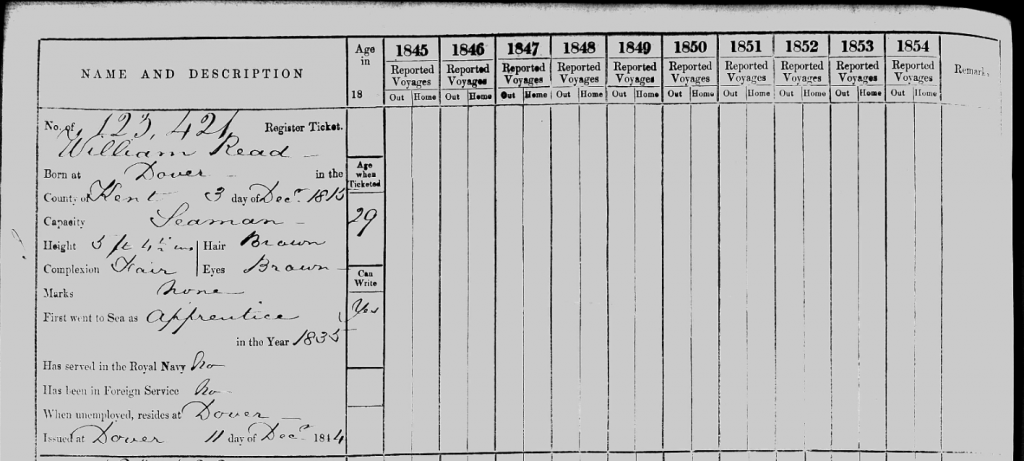
He was a very clever sea-farer and as a side line would do a bit of smuggling, a big bit sometimes. He was once caught by the French and kept in a damp dungeon, well underground, for 6 months, and it was thought he was dead by his wife and family. He got very good returns dodging and tricking the Preventative Men as the Customs Officers were called but he died a poor man in 1886 and his wife two days later, said to be of a broken heart, she sat with head bowed for those two days, they were together in the same conveyance [page 53] and buried together in St Mary’s Cemetery, Copt Hill.
I had one uncle on my mother’s side trained by his father and he was a clever seafarer and as quite a youngster had the repute of having brought the ship he was in (almost unaided) safely from the North Sea fishing grounds to Dover as the crew were all ill owing to some mysterious complaint that affected them all and rendered them helpless. He or his father is said to have at one time rolled at night a cask of Wine or Brandy to his home in St James’s Lane. I believe No 4 and on arrival found the belly of the cask too big to get indoors so sawed a piece out of the doorpost to get it in. I think it must have been my grandfather as I remember him living in St James’s Lane. Some of my forebears must have had a big streak of audacity and revelled in defying the Preventive [sic] Men, as my mother told me that when quite a girl she was sent with her pinafore containing a lot of movements of watches on which there was a heavy duty from Mr Drakes right past them and did not arouse any suspicion.
Dover was the best Port in this area and still is for a Fishing Fleet of small vessels, why can’t [?] some enterprising local people with vision resuscitate this valuable industry with all local shareholders, and make every employee on the smacks a gift of a few shares to hold all the while he continues in that employment [page 54] and to have the opportunity to buy shares the same as the General Public. It would be a paying proposition. The “Vaine” and the “Ridge” are good grounds as the French Trawlers know and why do they risk coming inside the 3 mile limit. It pays. There used to be good scallop grounds there, if there is now, the Frenchmen know it, I know scallops migrate but they can be found and at the prices of today it would be an Eldorado.
I have bought scallops at 4 a penny, large ones, from the dredgers that kept them in net bags of about 100 in the well of the vessel. At the Standard P. H. on Commercial Quay was a one-armed landlady who would clean and wash a 1d [penny] worth, supply pepper and vinegar free, a 1d of bread and a pint of beer 2d a jolly good meal for 4d. The scallops would be cut in four on the shell & eaten alive after being peppered, the roes being left till last, as a titbit. If you’ve never tasted them this way you have missed a treat in life, they are a trifle on the sweet side, delicious. I have also bought Oysters in the same way for 2/- [2 shillings, 10p] for 120, a long hundred, as fish is counted. Bloaters taken direct from the hang, cured with Oak Dust at 2/6 [2 and 6, 12 1/2p] per long hundred 120, ¼d [a farthing] each and taste like ham.
The Lord Warden Hotel was in its heyday, passengers arriving here to cross and finding it rough would stay till better weather [page 55] no motors to run them to and fro to London in an hour or so, also the Kings Head, Dover Castle and Royal Hotels in Clarence Place all did well and accommodation at times was difficult to obtain. When visitors looked out of the Lord Warden windows and saw seas sweeping over the top of the Pier those inside stayed put. On the “W” [West] side of the Pier were landing stages (2) used in the “E” [Easterly] gales, the pier itself was only about 30 ft wide. Townsfolk enjoying the top promenade in fine weather could look at the contents of passengers luggage as Customs Officers searched for contraband. I’m afraid we sometimes passed rude remarks as various articles of attire showed up, but generally the Customs men were very good. It was a scandalous arrangement with no overhead cover even if it rained or the seas were coming over in spindrift especially if the owner felt he would be glad to die from sea-sickness.
There was a Military Prison on Archcliffe Fort Road and I had an uncle a Warder at Brixton [?] Prison who frequently came down to escort prisoners from here to there, he always tried to let us know when he was coming so that I could go on the rocks and get him a nice lot of limpets, he must have had a good digestion as they were tough as leather, well, more like sorbo rubber.
Just over the bridge toward Aycliffe on the right hand side close to and adjoining the military ground was the “Ropework[s]” still standing but I [page 56] do not remember any rope being made there, perhaps that is because I lived in the opposite side of town. It was the property of Cullen, ship builder. On Archcliffe Fort Hill was Archcliffe Fort Brewery, later used as an Ice Factory and is now an Elementary School. Previous to the Ice Factory the natural ice arrived in the Granville Dock as the cargo of a Norwegian sailing ship in the summer chartered to H. Smith, Fishmonger and Ice Merchant, 42 Townwall Street, the ice was grabbed up in blocks by a toothed grip and swung ashore to flat trollies and removed to the Ice Well in Elizabeth Street, on Townwall Street opposite the Robin Hood P. H. of course it was melting all the time in the hold and when exposed on the trolley’s [sic], [obscured] were continually at work by hand to keep the water down, chips of ice were sought by the children who collected it from the back of the trollies as they passed through the streets, sometimes under a blazing sun. I wonder how much melted between the port it came from and the ice-well here, it was continually diminishing but it must have paid for itself or it would not have been shipped. In sending it away to order to other towns it was put in a coating of sawdust in a sack and tied up very closely.
Quite big ships used to bring grain in bulk for Bradley Road [?] Custom House Quay who had an overhead gantry from the top floor of their [page 57] store to level with the dockside up which grain was drawn in sacks and run across and deposited on the top floor of the store. The Oilmill was also in full swing and we boys used to get Locust Beans and other edibles, also plentiful was Linseed so Linseed Poultices were recommended for colds on the chest (I can smell them now) in competition with the old Russian Tallow on brown paper breastplates and applied as hot as possible (which stank worse I don’t know) but mother assured us it was the best thing and not to mind the smell. Almost as good as a Brown Powder concealed in a spoonful of jam that we were at times treated to, the smell of the powder made one’s stomach revolt and start retching before taking the spoon, it was cruelty to healthy young animals and we knew we didn’t get spoonfuls of jam for nothing. Then the old disgusting Brimstone and Treacle in tablespoonfuls, all gritty under the teeth. I shall never forget it, and mother inviting us to have some more. It’s a wonder I ever had treacle afterwards. My thought was always that when I was a man I would like to live on Pickled Cabbage and Strawberry jam but its strange, I have never had any partiality for them since becoming an adult.
The Friendly Society Convalescent Home in Front St where is now a railway siding used to be nearly always full up with patients to be seen daily taking their walks round the docks and exploring the cliffs and hills although some preferred the Sea Front and the Beach.
Commercial Quay [page 58] was about three parts licensed houses, now demolished. It seems strange to think of the streets that have disappeared in the Pier Area. Oxenden St, Oxenden Lane, Paradise Street, Round Tower Street and Lane, Water Lane, Elizabeth St, Great St, part of Council House St, Swan Star St, Blenheim Square, Finnis Hill or Court, Hawkesbury St, Bulwark St. There was a Baker in Oxenden St named Rolfe who with his two-wheeled cart used to go around the country and many many times I have seen him returning down Castle Hill after a long country round as late as 9:30pm and even later. Where would you get a man today to make, bake and then take his wares for sale, he had no eight hour shifts and yet he always had a cheery greeting for us although we were no customers of his. That was the type of man that made England, work never hurt anybody although I don’t believe in too much of it, today everyone wants short hours, big money, cheap food, all sorts of pleasure thinking they are the salt of the earth, but there will have to be a stocktaking and some retrenchment, it isn’t a bottomless purse, if we go on as present demanding more and more we shall find ourselves in Carey Street [synonym for bankruptcy]. Other countries look on awaiting what they hope will be our collapse so that like carrion they can pick us to pieces. Unfortunately we have big mouthed jacks-in-office with parrot folk disseminating their idle talk to all and sundry (by their deeds ye shall know them).
Where Scotts [page 59] the Dyers is, next to the Grand Shaft, was one of Mr Higgs stores, he owned Lime Kilns Birchfields and I believe was a good builder, his own workmen said so. The houses he built were nearly all four square, I believe one at the top of Park Avenue “Verulum” he built, and two semi-detatched at the corner of Priory Gate Road & Folkestone Road, also many others if there’s any doubt remove a brick and his name or initials will be found on it, he was a most conscientious tradesman and his work is a credit.
There was a fishmonger named Dringabier in business where the Snargate St Roman Catholic Church now stands, he had the best quality fish, poultry and game and supplied nearly all the Officers Messes. At Xmas he would have a whole Deer hanging up outside his shop on show before being sold as venison. The first fried fish shop to open in the town was nearly opposite the Clarendon P. H. and was run by a man named Rolfe who did all his own frying and had men assistants named Nevis[?] in white overalls as waiters, it was a deep shop, well lighted and it smell good, and it was, not much batter and cooked to a brown crispness. I think they used Cotton-seed oil for frying and for 2 ½d you got a real good plateful with plenty of fish, the potatoes were boiling hot and tasted almost as good as the fish as they were cooked a golden brown, not like now when its half batter and seldom crisp; as boys if we could afford it we had another plateful and had a proper gorge, but one was really quite sufficient for any [page 60] ordinary person. Then there was Courts, Wines & Spirit Merchant with its huge cave cellarage, next to, and behind the Masonic Hall. Courts pair horse vans would leave piled up with cases and baskets of Wines & Spirits for other towns and to be distributed in Kent. It was an oldfashioned firm with good connections & doing a thriving business but for some reason was closed down and in the 1914-18 War. The premises were used as a Naval Hostel and Canteen for men of the Channel Patrol from the Drifters, Trawlers and Minelayers and other craft in the Wellington Dock where they laid when in from sea for next repair, replenishing or refilling, one could walk at night across the dock by stepping from boat to boat at times. It was a deathtrap and many who had spent the evening ashore were drowned as there were no lights allowed and the gangways to the quay did not always have the rope for holding on to just where they were expected to be, consequently many stepped as they thought on the gangway but stepped on air, a shout or two and if lucky the chap was got out, but many were lost. It was said over 100. I know a small child fell in the brook near the Brewery, Dolphin Lane and we could not find the body although a search was made to the sluices at the Town Mill, so the Harbour Board allowed the gates of the Dock to remain open as the tide fell and the childs body was recovered, also several of the RNVR [Royal Navy Volunteer Reserve] who had been reported as missing or deserters. Then a fence was created with wires to prevent anyone falling over and all had to enter by the [page 61] gates provided, and in charge of a picket, even then some got drowned in trying to get aboard without passing through the gate because their vessels were not near the opening.
The “Clarence Music Hall” later the Hippodrome, Snargate St was a rough shop at times and father forbade us boys ever to go there, but I did go once to a Boxing Day Matinee as they had glaring posters in colour of someone who was fastened down to the railway track and a train approaching belching smoke and fire entitled:- The Midnight Mail. My chum as well as I thought it a thrill and decided to go. I think it cost 4d but we saw little of anything and soon left as soldiers began throwing pots about and we did not want to get mixed up in any trouble and so let our parents know we had been there.
At the Wellington Hall on one occasion there was a magic lantern show. I forget if by payment or invitation, I think the latter and I think it was given by Major Scott of 9 Victoria Park who was very well known in the town and often did most extraordinary things, one of the slides was a Windmill and as it turned round and round it ground out sweets onto a tray which were brought round to us and we could have all we wanted while they lasted.
Of course we must not forget Mr Painters shop 173-174 Snargate St. The toy shop where all were welcome and he would not let you go away empty handed or disappointed if he could help it, he kept a real good stock at prices from 1d upwards and had few competitors, certainly not Drapers as it [page 62] happens today.
At No. 176 was Gouldens Book Shop & Library (nearly opposite the stone outside the “Standard” Offices bearing the words “Here stood Snar-gate taken down <date>”). The Library was well patronised by the gentry, although at Victoria Park cases of books from London were the usual source of reading, and the cases bore the name I think of “Mudio” [?] and were interchangeable before being returned. I think it was a form of Book Club for good publications. For comic papers there was only Ally Sloper and Punch and the only time I saw them was when I had my hair cut, costing 2d, Mens shaving 1d, and was always willing to miss my turn so as to have a good long look at the pictures, later came more interesting Boys Books. “Deadwood Dick” banned by father, but I managed to get a secret reading at times it was so thrilling, then Frank Reade’s most wonderful exploits that we thought impossible or far fetched, but many of his ideas have been brought to fruition during the wars and perfected what was the ideas of Deadwood Dick, Buffalo Bill and Frank Reade’s hairraising ideas and exciting adventures. It is difficult to realise today what wonderful chaps we thought them in their escapades.
Jarrett the Tailor had his shop opposite the Soldiers Home and was the contractor for all corporation uniforms if the successful contract was his, he made all the police uniforms locally, bets materials and trimmings, two fittings for every man and the uniform was a [page 63] credit to him, especially if you knew as I did the funny figures he had to clothe. Sergt Barton for instance was so awfully fat that there was no sideways and he filled up the doorway to the Station, and there were other fat ones as well as the medium and skinny ones. At that time nearly all policemen had fat and projecting abdomens and wore full beards, now they have neither beards or be [deliberate blank word here].
In Town Wall St was Walter Day Adams “Wine Lodge” and wholesale stores my brother Harry worked there about 65 years ago. The pair horse vans would be loaded up overnight to leave early morning for Ramsgate. I think “Waresfull” Wine & Spirit Merchant and other places; driven by G Church (who later on was employed at Rubies’ or Dick[esons]) that part of the business fell off somehow although the Bars are still Licensed for retail business, but Mackesons, Hythe have the rest of the premises as stores.
Opposite are two peculiar looking houses without windows, the reason being that owing to the window tax at one time in force (and now abolished)all the windows are at the back of the houses. Now Camden Crescent is down you can see the front doors at the back. The Round House as it was called opposite the Chandos P. H. because of its dome (disappeared in the war, owing to the shelling from Cap Griz-Nez) was always remarked on as a curiosity by visitors. I have heard the dome was built as the owner wanted at least one room where the Devil could not hide [page 64] in a corner, of course in those days drink was stronger and perhaps some folks really felt the Devil was too close for comfort. A parson at one time lived there.
The Grand Hotel was private houses one being occupied by Steriker Finnis, Timber Merchant, now Tolputts Biggin Street at back of Co-op. The Tanyard at Stembrook was a flourishing business and employed many Dovorians. Fell-mongering and Tanning but it closed down, another big loss to the town. The Mill at Stembrook was run by Mummery but has finished. Braces Mill (later Hogbins) is still standing in Mill Lane, St James Street but does nothing and is falling into a bad state of dilapidation. What will revive our old industries, or start new ones. Certainly not the Harbour Board they have practically ruined us already, or Rates at 22/- in the £ [£1.10 in the £1] (including Water Rate).
[Someone has underlined this paragraph in the manuscript, a bit of a rant] Our late Mayor, Cocky Goodfellow (as he was known as a boy and still is) has already done more to ruin Dover than anyone else and his arrogance and ego have become a byword, he was brought up in Woolcomber Lane, has always had a swelled head & by hanging on to the Socialists & Co-op has wormed himself into the position he held, better for Dover if he had never existed. I don’t know of one redeeming feature in his career, if I did I would credit him with it. Russel St Chapel at one time and now so I understand he is a big noise in the Nonconformist Church. If he [page 65] can hold that position his conscience must be quite dead, his party have just acquired the Girls Orphan Home 96-98 Folkestone Rd, and there is a lot of Sunday work going on, cutting down trees etc as other folks are going and coming to & from Church. In his position he should not allow it, rather, six days shalt thou labour etc remember. Its not to the credit of the Nonconformist Community that this work is allowed as it could be done on weekdays.
In Caroline Place was the Youths Institute and at the back of Tyglesden & Graves a large room for the St Martin’s Society, both these were run for the benefit of adolescents so that they could have clean healthy recreation especially during the winter and dark evenings, the latter was run by Mr Cowley Blackman (a bachelor) Grocer of Biggin St who was always interested in anything to do with St Martins and no doubt that is why it was so named. He used to help with the Church Services at Guston and seemed very sincere in all he did, he got me when a boy and could sing Alto to take Anthem Parts at Curch Festivals if I could be spared from St Mary’s in the Castle or New St James.
The Granville Gardens next to No 1 Waterloo Crescent were surrounded by a high iron fence and inside that a high hedge and could not be seen into from outside the walks round and about the Bandeland were twisting and had high hedges with occasional seats for four or six set well back [page 66] into it and screening them from the wind, it was very comfortable and nice for a certain amount of privacy and was appreciated by courting couples. Opposite on the beach during the season was the Ladies Bathing Machines on wheels that were lowered into the sea as required on their broad wooden tyred wheels 8-10” [inches, 25cm] wide to a short distance into the water, access was obtained by walking a plank fitted to reach from the beach to the doors about 4ft [feet, 1.2m] high over the beach, there being two compartments and before the occupants could get out on to the steps to reach the water they had to don a regulation dress provided so as to suit Mrs Grundy. They nearly all looked alike if on was lucky enough to see them but more often than not they hung on to a suspended overhead rope and keeping their feet well up the steps bobbed up and down without letting go of the rope. A fixed board screened the steps either side so that those sitting on the beach could not see them. The dress was thoroughly efficient as it covered them up very well, there was nothing to indicate if they were bandy or knock-kneed and from the loose fitting costume on could not tell 16 from 60 although they all squeaked as the water surged up and partly enveloped them. I don’t remember ever having seen one swimming, the dress was [page 67] too cumbersome and dangerous, not like now when women in scanty but smart costumes can enter for long distance races and compete on a level with men.
On the Sea Front were to be found Bath chairs at appointed places, some sprung on leather straps, others less smart, so that invalids or others could employ them for and by the hour to be taken where they wanted to go, the man attendant pulling by a long handle with a T piece attachment to pull on, or by putting it in the small of his back [to] retard its progress down hill. I have often got behind unbeknown at the time to the man in front until I started to push to help him get someone up to Victoria Park.
Broughams, Victorias, Pony Chaise, Goat Chaise, Char-a-bancs etc would all be seen waiting for customers at the different Cab Ranks close to the sea-front railings. The Char-a-bancs owned by Fisty Miller & G Tyler used for a long time to stand around the Monument, which had a square of heavy railings with a big gilt ball at each corner pillar (that square much reduced in size has been altered to circular during the War). Some of them with 2, 3 or 4 horses attached and boards giving their fare, route, and time of departure, fare actually 1/6 [one and six, a shilling and 6 pence, 7½p) for an afternoon drive of 2½ -3½ hours into the country. Of course there was no motor traffic and in looking back seeing the large amount of trade being done then in the town its incredible to think how we traded at all.
[page 68] The Docks and Quays were piled high with stacks of assorted lengths of timber (brought in by ships from the Baltic etc) or loaded on horse-drawn timber tugs or jigger wheels to be taken to the timber yards in Pencester Road now Pencester Gardens for Sir William Crandall or Finnies at the rear of the Co-op (Now Talputts [?]) or to the Railway Station to be taken away to other towns. All coal brought in in sailing vessels and discharged by manual labour in huge baskets filled in the hold, raised by counter-balance and sometimes the added weight of the men, or by winch by man labour, men running the plank from ship to shore to push and tip the coal into tip-carts for Mills, Breweries, Limekilns, Brick-fields, Malthouses etc some of the Mills had water auxiliary power. The Fishing Industry, Cross-channel Boats, Packet Yard, Customs, Continental Sheds and Locomotive Sheds, South Earham [?] & London, Chatham and Dover Railways all in full employment without the hustle & bustle of motor-traffic and power. We got there just the same, everyone was more contented money was small but there was not that extravagant way of of earning £1 and spending £1-1-0 [One pound 1 shilling and 0 pence].
Pictures & Dances may be quite alright within reason but not to make them a religion and never miss a service. When the telephone first came to the town it was the old “Bell” or Edison Bell Co, they had a store for [page 69] many years in Laureston Place and their exchange was behind “Harts” Electrics Shop, Waterloo House, Market St on the top floors, now the National Provincial Bank. One of the oldest employees named Staines was transferred when the GPO [General Post Office] took over, he was a great friend of mine over all the years and died a year or two ago in retirement.
The Waterworks which is one of the finest legacies we could have had from our forebears has never failed. Mr Thomas was I think the first Surveyor I knew to live at Castle Knoll although I have known all his successors, Mr Boulton Smith being the last to reside there but the house was shook up during the War. (it was just outside his front door that at night during the evacuation from Dunkerque (Dunkirk) when I was on duty that a shell fired during a raid burst just above me, stripped a Laburnum tree and the blast shook me up so that I found four days later that I had crepitus from fractured ribs, but as there was no one to be obtained for a relief I was strapped up and carried on, unfortunately I never reported sick & although my lungs were seriously damaged (as later found out by XRays) I was not eligible for consideration in any shape or form I am still very short-winded after any exertion and apt to take cold easily). The old original beam engine is still a stand-by [page 70] since one of the new pumps was installed, but when the other one is put in I expect the old one will be taken down and put in the Museum its pretty ancient now.
In what is now known as the covered market was a home killed meat market with large scales for use and a scale of prices for their use, also the charges for different stalls and gear. There were no foreign meat shops then. Almost every Saturday morning I was sent to fetch hand made sausages or sausage meat (ordered the previous Saturday) from a Mr Ayers who came in from the country, lovely sausages seasoned with Sage, all hand chopped and all meat, shall never see or taste the like again. At times if lucky we also got a set of pigs chitlings, we called them pigs innards, they had of course been cleaned but mother always turned them inside out and cleaned them again before cooking they were lovely, both cap and plaits [?]. Once as I took a set home in a bucket I saw two men with the catch-pit open at the bottom of the hill to remove the gravel, so put my bucket down and watched operations the men being down in the pit, presently one said something to the other and both stood up and sniffed and one said:- Whats in that bucket and when I replied “Innards” they both soon told me to clear out, they thought [page 71] it was rotten and said so with a few adjectives.
Castlemount was then kept by a Mr Chignall as a school and was known as Chignall Gardens. At school holiday times if my father was not on Night Duty he would sleep there owing to the staff being nervous. We were the only outsiders to have a key of the gates, it being hung up handy, indoors, in case of being required and for our use if going through to Leybourne Terrace or Charlton area Via Taswell Hill, but we had to be sure not to lose the key. I remember being sent with my brother Harry to Buckland House with a broomstick to carry a goose home which was suspended on the pole resting on our shoulders with its head tied up so as not to drag. Owing to the mysterious loss of geese, ducks and hens without any trace of where they had gone lasting over a considerable period it was decided to watch & so if possible clean up the mystery from inside Buckland House Grounds. My father was able to climb in after the lights were out and thought maybe he would find or see a Fox, but as dawn broke he saw a man carrying a dead goose, it turned out to be an employee, either gardener, builder or some sort of management who had a grievance or fancied grievance and showed his resentment in this way, the birds being all buried in a rubbish heap well [page 72] away from the house, father arrested him and was shown where they were hidden. I don’t know what happened to him but father was given the one the man was carrying. I remember on the way home passing a row of houses in course of erection just built up to ground level. Could it have been Harold Terrace? I think so, or Leybourne Rd.
Another time on an Easter Monday “Ally Sloper” had an advertising stunt on the hill this side of Union Road Gas Works, near Diggles Tower. A big balloon with the words Ally Sloper in big letters around the middle of it. It was captive and was to shower thousands of copies when at its highest point. It was a bit windy and my brother & I were asked to help hold it steady while it was being filled, by holding on to the ground rope, it pulled and tugged in the wind swaying all over the place during inflation till with increasing buoyancy it came at us sideways and flattened us out, as soon as it lifted sufficiently and rolled we both cleared out, the bundles were afterwards let fall some without being untied. I don’t know what happened then but no one was injured so I suppose it was deflated safely.
At the back of the Wellington P. H. Biggin St I remember attending a Circus (I think it was Ginnells) where there were 3-4 elephants, although young I wondered what would [page 73] happen if anything went wrong because I thought the stairs to the approach were not strongly enough built, what remains clearest in my mind was a clown and seeing the elephants sit down on tubs. It seemed such a strange place to have a circus. The entrance was from the side of the Wellington P.H.
It used to be interesting at Michaelmas Time to see the farm employees for their annual holiday come in and make it their day. Any changes of service would be arranged for them and farm waggons could be seen loaded with furniture and household effects coming from or going to another situation, others who were staying on bought a new Whip, Books, Clothing, Whelks and Winkles and of course some Beer 2d Pint but they had little to spend on riotous living when many only got £10-12 per annum live in. On occasions when they had to come in during the year with corn etc they usually had a sub and that was deducted from their pay. Sometimes they got drunk and had to be locked up charged with being Drunk in Charge of a horse and cart, for their own and everyone else’s safety and the farmer notified so as to fetch the horses and later bail the men out, he would pay the fine and stop it from the clearance at Michaelmas, so it was only suspended payment for them. Some masters would overlook it as they usually understood the temptations they had, and after all what was a day out if you had no [page 74] enjoyment out of it. I think if the horses had been left alone they would have got back safely but the risk of allowing that was too great for everybody. Better safe than sorry.
In the Admiralty Pier Turret there is a 81 ton gun (I have been told two of them) when that used to be fired the Town Crier would go around and warn householders to keep their windows open to avoid breakage by concussion, it was not fired very frequently and then I understand only at half or quarter charge.
The Town Crier in his uniform and Bell which he rang to call people to their doors shouted out “Oyez, Oyez, Oyez” to inform them of what was going to happen. At other times he would announce such things as the water being turned off or to advertise a “Sale”, he was allowed to do this at the end of any announcement something on these lines “Do you know my dear Mr So-and-so has a sale on, lovely sheeting or shirtings, socks with close[?], fevrers[?] of laces, you never saw such a show and all so reasonable, I shall be there so don’t pass without speaking. Mrs – is sure to be there, trust her, as her hat begins to be familiar, you know don’t you there’s sure to be a big crowd. Goodbye”. He was usually a bit of a wit and of course got paid for the advert.
When very young I used to go up the Grand Shaft, via Mr Martin’s steps. In The South Front Married Quarters where my eldest sister Mary was in Quarters, she [page 75] having married Robert Hearst, Colour Sergeant of the Royal Irish Rifles, after a year or two the Sergeant was shifted to Guernsey, Channel Islands. They embarked from the Admiralty Pier (which was then only about 30ft wide and finished at the Turret) on the well known troopship “Assistance”. My mother sent me up on the Castle steps to wave a handkerchief as the ship cast off as I did so want her to know I was sorry she was going away but of course at that distance she would not see me, although the trees were not such a screen as now, the Regiment later went to Mulligan, Ireland and from there she wrote asking if she could come home as she felt so ill, Mother wrote to put it off a bit as Harry was only just getting over an illness, then a telegram arrived to say she was on her way, she arrived a day or two later and looked very ill and was dead in eight days, she was beyond help on arrival with a growth on the Liver.
It was the only time I saw my father shed a tear, my mother brought up her three little tots for a time, then my sister Lydia gave up her young man on purpose to mother the children and although at that time it was illegal to marry a deceased sister’s husband she did so and about eleven months later she died in her confinement in London, mother bringing the baby about two days old to Dover with the other three and had them for some years. What a mother we had.
At times we had boiled suet pudding (a good filler) and treacle, [page 76] it was the real old black treacle, no golden syrup then. We got it from Sugar Briggs shop, Trevanion St (he was the verger at New St James’ Church) we had to take a basin to put it in which was put on the scales and weighed and then the treacle contained in a large container above the scales with a close fitting flat tap was turned on , it ran out like tar and when the correct weight was shown was suddenly turned off. My brother carrying a basin home up Hubert Passage lifted the paper to put his finger in just as a boy threw a dry turf over the wall from the first meadow at the top of Hubert Passage, he did not want any pudding in case of its being guilty but the turf had been allowed to drain off its surplus before being taken home and it was too black to see if there was any sediment, it all passed off alright.
I have seen quite large Eels in the Dour at Dieu House Lane and squirrels leaping and running about in the trees that did stand overhanging the footbridge. Even the brook in Dolphin Lane next Limeys Brewery was alive with leeches but chemicals from the Paper Mills have killed them all off from Buckland downwards. It’s a wonder the White Swans, and Black Australian Swans with their red beaks that looked so handsome remained as long as they did. At Willow [page 77] Walks (at the back of Buckland Avenue) a backwater from the dam of the brook above Mannering’s Mill we used to take our jampots like many other children to catch Minnows but that has all been filled in and built on now.
Cherry Tree Lane (now Avenue) was a very narrow rough surfaced road and few buildings if any. I think the only one “Barton Cottage” now numbered 21. Beaconsfield Road extended from London Rd to the postbridge beside Sedgemead House, then over the bridge to Barton Path and old Charlton Church (now pulled down) and where we used to see the Clergy and Choir in surplices and cassocks in procession from the Church to go in a side entrance carrying banners and different things, as a spectacle it looked very pretty but I was brought up a low church Protestant, (not with any of the Catholicism as it unfortunately is today with its Rites & Practices) which I think to attend is hypocritical so would have nothing to do with it. A good Catholic is a sincere person and so I hope is a good Protestant but why practise Catholicism in the Protestant Church. I don’t hold with gaily painted effigies and other pagan rites. We all think we’re right, let us continue so and have no bitterness, if a man will only think for himself he’ll know what is right.
The footbridge when removed for the road bridge to be built to carry the road to the newly developed districts in the Barton Rd [page 78] area was put in position across the Dour just over the bridge beyond Mannerings Mill, Lower Road, River and I believe it is still there. There was in those days a lot of pilfering on the railways, what could be expected when goods porters were paid 16/- [16 shillings, 80p] per week, less 3d for a sickness benefit and I have known married men with families at that rate, but you could have a pass free anywhere, now when they are getting big money they still have that privilege but others have to pay treble the former charges, how nicely balanced it all is. If all had to pay the same it would mean more revenue and so reduce the costs all round, or if as the C[?] [abbreviation is unclear] used to do they ran excursions at times at a very cheap rate and well advertised them the trains could be run full to capacity and it would be a good bit of business as well as letting the shareholders (us) have a little benefit of some sort. I have been to Brighton return for 5/- [shillings, 25p] on several occasions. I’m not saying this as if its sour grapes to me. It’s the right thing to do.
The first foreign meat shop was I think “Hogbins” next Biggin Court, Biggin St and he soon made a good business of it although the genuine butcher could not say anything good about it saying there was no goodness in frozen meat, but later when company shops such as Fletchers Nelsons, Argentine etc opened up of course they took most of [page 79] the trade. Meat was very cheap. In Priory Street I could get a good leg of mutton for 2/6 [“two and six”, two shillings and sixpence, 12½p] or less, real good stuff, and on Saturday evenings if sales hung up, there being no refrigerators or ice-boxes it was sold off at Dutch Auction for as low as 1d per lb [a penny a pound, approx. 1/2p per ½ kilo] at the various shops and I have seen when no one would pay even that joints flung out to folks looking on gratis. I have seen 30lb of mixed:- Beef, Lamb, Veal, Mutton & Pork sold for 2/6.
There were no rubber soles or heels to boots but iron heel and toe tips and hobnails, heavy as lead. Elastic side boots were common for women and some men, when “Oxford shoes”, or low shoes came in they were known as High-lows and soon became popular, now it is the exception to see mens boots for sale unless for a special purpose. Boys when leaving school were often apprenticed if their parents could afford to keep them for nothing for a few years but it was a strain on the housekeeping to keep a growing boy, nearly a man clothed and shod with a little in his pocket and a void inside that could digest and enjoy huge quantities of food. I only hope if they were ever in the position to show their thanks in some tangible manner they did so, but of course good parents did not count the cost, their recompense would be the satisfaction of knowing they had made a success of life at [page 80] the trades or callings they had started on.
At intervals notices for the sale of East Army Horses would be posted up on the Hoardings and advertised to be held in the Market Square, usually at 11am. The horses would be bought in from Shorncliffe or Canterbury or wherever there were cavalry and the low horse copers and dealers of this area of Kent were always strongly in evidence as well as Gipsies or Pikeys waiting for the sale to start. After a preliminary opening by the Auctioneer as to conditions of sale etc a lot would be shown and the dealers ask for it to be trotted up and down to see its paces, then some uncomplimentary remarks about the horse would be made and I never heard any good ones, and when asked to make a bid a ridiculous one would be made say:- £1 a leg and after a lot of banter it would get knocked down to one of the crew at a very low price, and so it would go on till all were disposed of. I never saw any taken back again so between them they had a good time, especially when one heard what the Govt [Government] were paying for horses, they were not all vicious or unfit, if they were they should have appointed another buyer.
Most working class families owned an iron-foot for fathers to use in repairing footwear or replacing tips on hobnails, it saved a lot. I can hear my father [page 81] saying, lets look at your boots son, and then say take them off, get out my toolbox bring in the foot and I’ll do them before going on duty. I still have his iron-foot that he had when apprenticed as a boy at his home in “Street”, Nr Glastonbury, Somerset, it is a wrought iron foot set in a wooden post and has done good service in my family, as he joined the Army after running away from his apprenticeship and fought in the 1857 War in China [Second Opium War] and at the taking of the Taku Forts [Probably August 21 1860] it must be well over 100 years old. I don’t suppose I shall use it again. It was useful when my family were young and my wages 24/4½ week [24 shillings and 4 ½ pence, about £1.22] as a Dover Police Constable in 1900, during the Boer War and although a novice at that job it did save my pocket quite a lot.
In butchers shops you could see hanging up Haslets consisting of pigs or sheeps lungs, wind-pipes and other offals which would be made into Haslet Pie with plenty of seasoning but I didn’t want any, we very seldom had one, then some folks would buy a half or whole bullocks head & there was quite a lot of meat on the cheek but we never had any, half a pigs head we did sometimes have but I had no stomach even if hungry for shout, ears and I didn’t like the look of the teeth, a brawn mate from it I could not eat altho I have bought a hot faggot and eaten it, goodness knows what was [page 82] in it but it looked nice and was well seasoned. I expect that was only to disguise it.